Gooliez
Apprentice elf
So some of these question will probably sound like obvious answers, I'm pretty sure i know the answer, but best to ask instead of blowing things up in my first year.
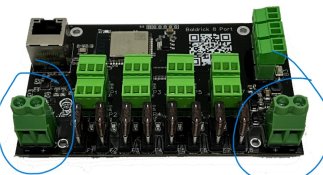
my setup is currently made up of 3 x baldrick 8 controllers. currently i have 2 x meanwell 350's and 2 x generic 400's in stock and will definitely need to order more going by using Pixelmapr as a guide ( even though it may not be accurate, it'll give me some ballpark idea)
1. can you connect multiple power supplies to the Controller boards. All videos i've watched show 1 supply, where the positive and negatives get split to both sides of the controller. so can i connect 1 supply to one side and the second to the other. Or even 4 power supplies? or is it a "i need LARGER power supplies. Can there be too large of a power supply ?
2. ( subquestion to 1) If so, can these power supplies be mixed and matched, eg brands / Wattages?
3. lets say i have a port and the full 750 pixels used, I power balance at the start and end of the string ( lets just say it's a giant ring) then theres not enough power getting to the middle of the string. Would i be better off using a separate power supply to inject OR run a new line from the power supply that's connected to the original controller?
4. 1 Big PSU or multiple Small - more beneficial / price / ease of wiring
i'm sure there's more questions, but this is whats coming to mind so far
my setup is currently made up of 3 x baldrick 8 controllers. currently i have 2 x meanwell 350's and 2 x generic 400's in stock and will definitely need to order more going by using Pixelmapr as a guide ( even though it may not be accurate, it'll give me some ballpark idea)
1. can you connect multiple power supplies to the Controller boards. All videos i've watched show 1 supply, where the positive and negatives get split to both sides of the controller. so can i connect 1 supply to one side and the second to the other. Or even 4 power supplies? or is it a "i need LARGER power supplies. Can there be too large of a power supply ?
2. ( subquestion to 1) If so, can these power supplies be mixed and matched, eg brands / Wattages?
3. lets say i have a port and the full 750 pixels used, I power balance at the start and end of the string ( lets just say it's a giant ring) then theres not enough power getting to the middle of the string. Would i be better off using a separate power supply to inject OR run a new line from the power supply that's connected to the original controller?
4. 1 Big PSU or multiple Small - more beneficial / price / ease of wiring
i'm sure there's more questions, but this is whats coming to mind so far