
Navigation
Install the app
How to install the app on iOS
Follow along with the video below to see how to install our site as a web app on your home screen.
Note: This feature may not be available in some browsers.
More options

You are using an out of date browser. It may not display this or other websites correctly.
You should upgrade or use an alternative browser.
You should upgrade or use an alternative browser.
Coro Plastic vs. Foam Board
- Thread starter JimmyW
- Start date

Full disclosure — I make props commercially, so I've worked with both. Honest take:
Coro is my pick for most props. It's about a third the weight of foam board, handles weather well, costs less, and flexes in wind rather than snapping. Big advantages for anything on a roofline or exposed to gusts. The catch: it needs proper surface prep before painting or printing, or the artwork will flake — that's why you see so many coro props with peeling paint.
Foam board wins on finish — dead flat, no flute lines, takes paint beautifully. But it's heavier, dearer, and more brittle.
Short version: coro for large or elevated props, foam board where it's viewed up close and the finish justifies the cost.
Coro is my pick for most props. It's about a third the weight of foam board, handles weather well, costs less, and flexes in wind rather than snapping. Big advantages for anything on a roofline or exposed to gusts. The catch: it needs proper surface prep before painting or printing, or the artwork will flake — that's why you see so many coro props with peeling paint.
Foam board wins on finish — dead flat, no flute lines, takes paint beautifully. But it's heavier, dearer, and more brittle.
Short version: coro for large or elevated props, foam board where it's viewed up close and the finish justifies the cost.

Generally agree with CPA.
In the USA it is not easy to get the PVC foam board, all the US vendors are cutting coro, which is much lighter, easier to work with, and performs well overall.
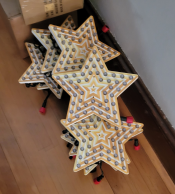
I do have a few PVC stars (imported from Ink Creations and distributed by Your Pixel Store). They're much heavier but they work well and they look great, so I'm glad I bought them.
Overall, you can't lose either way... if you like the prop, you might as well buy it regardless of the material.
In the USA it is not easy to get the PVC foam board, all the US vendors are cutting coro, which is much lighter, easier to work with, and performs well overall.
I do have a few PVC stars (imported from Ink Creations and distributed by Your Pixel Store). They're much heavier but they work well and they look great, so I'm glad I bought them.
Overall, you can't lose either way... if you like the prop, you might as well buy it regardless of the material.

JimmyW
New elf
- Joined
- Jun 4, 2026
- Messages
- 18
- Thread starter
- #4
Appreciate your honest review, and good to know that you have used both types of material and why.Generally agree with CPA.
In the USA it is not easy to get the PVC foam board, all the US vendors are cutting coro, which is much lighter, easier to work with, and performs well overall.
I do have a few PVC stars (imported from Ink Creations and distributed by Your Pixel Store). They're much heavier but they work well and they look great, so I'm glad I bought them.
Overall, you can't lose either way... if you like the prop, you might as well buy it regardless of the material.
View attachment 31256
JimmyW
New elf
- Joined
- Jun 4, 2026
- Messages
- 18
- Thread starter
- #5
Have you used both types of props in your display, and how do they hold up in the Queensland weather?Full disclosure — I make props commercially, so I've worked with both. Honest take:
Coro is my pick for most props. It's about a third the weight of foam board, handles weather well, costs less, and flexes in wind rather than snapping. Big advantages for anything on a roofline or exposed to gusts. The catch: it needs proper surface prep before painting or printing, or the artwork will flake — that's why you see so many coro props with peeling paint.
Foam board wins on finish — dead flat, no flute lines, takes paint beautifully. But it's heavier, dearer, and more brittle.
Short version: coro for large or elevated props, foam board where it's viewed up close and the finish justifies the cost.
I’m actually very disappointed in the lighting community on this subject. Jimmy had a very good question which he asked and nobody as responded except merryoncherry and myself.

I responded to the poll. Its also not even 24hours since the OP. Allow some time for people to actually see itI’m actually very disappointed in the lighting community on this subject. Jimmy had a very good question which he asked and nobody as responded except merryoncherry and myself.


Keep in mind that traffic to the site wont pick up for another month or two - usually post-mini's is when it jumps up, peaking in November and then going completely dead by the 2nd week in January :-D

Katekate
Senior elf
if it was answered, does it really need more answers?

i also have both.
So far the PVC foam board from Ink Creations has held up great in Sydney over 2 seasons. The prints look fantastic (I have stars and the set of gingerbread people).
Everything said above is spot on.
Yes, its quite a bit heavier and great for ground based props or smaller items (just my opinion). And you do need to handle it with more care - if you drop it I think there's a reasonable chance it will break - I cracked a small star. On the plus side I was able to glue it back together. Another plus is you can drill it easily if you need to add different mounting holes.
Definitely a case of horses for courses - For me I would continue to use coro for large items or anything that's hanging on the wall or up on the roof where I want it to be light enough to handle up on a ladder and I'd be worried about dropping and snapping it. For ground based I would use either depending on who had a design that I liked.
So far the PVC foam board from Ink Creations has held up great in Sydney over 2 seasons. The prints look fantastic (I have stars and the set of gingerbread people).
Everything said above is spot on.
Yes, its quite a bit heavier and great for ground based props or smaller items (just my opinion). And you do need to handle it with more care - if you drop it I think there's a reasonable chance it will break - I cracked a small star. On the plus side I was able to glue it back together. Another plus is you can drill it easily if you need to add different mounting holes.
Definitely a case of horses for courses - For me I would continue to use coro for large items or anything that's hanging on the wall or up on the roof where I want it to be light enough to handle up on a ladder and I'd be worried about dropping and snapping it. For ground based I would use either depending on who had a design that I liked.
JimmyW
New elf
- Joined
- Jun 4, 2026
- Messages
- 18
- Thread starter
- #11
Cheers. Appreciate you sharing your experience.i also have both.
So far the PVC foam board from Ink Creations has held up great in Sydney over 2 seasons. The prints look fantastic (I have stars and the set of gingerbread people).
Everything said above is spot on.
Yes, its quite a bit heavier and great for ground based props or smaller items (just my opinion). And you do need to handle it with more care - if you drop it I think there's a reasonable chance it will break - I cracked a small star. On the plus side I was able to glue it back together. Another plus is you can drill it easily if you need to add different mounting holes.
Definitely a case of horses for courses - For me I would continue to use coro for large items or anything that's hanging on the wall or up on the roof where I want it to be light enough to handle up on a ladder and I'd be worried about dropping and snapping it. For ground based I would use either depending on who had a design that I liked.

I also have both. I have found the corro props become brittle and quite easy to break after a couple of seasons in the Qld Sun. I think the only vendor in Aus that does the foam board is Johnno from Inc Creations, and his quality is really good. Fortunately I have not dropped any of them (yet) so cant speak to the durability of it, but have dropped quite a few corro props. New, no problem. Couple of season old, break / split.
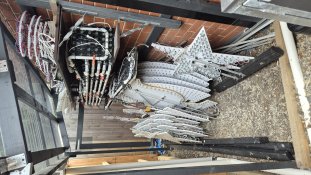
If you look after your props in the off season, and can store them out of the sun, you should easily get multiple seasons out of them irrespective of using corro or PVC foam board.
If you look after your props in the off season, and can store them out of the sun, you should easily get multiple seasons out of them irrespective of using corro or PVC foam board.
JimmyW
New elf
- Joined
- Jun 4, 2026
- Messages
- 18
- Thread starter
- #13
Appreciate your advice, particularly about the sun and how it degrades the props. I suppose it’s a good opportunity to update the layout and the technology tooI also have both. I have found the corro props become brittle and quite easy to break after a couple of seasons in the Qld Sun. I think the only vendor in Aus that does the foam board is Johnno from Inc Creations, and his quality is really good. Fortunately I have not dropped any of them (yet) so cant speak to the durability of it, but have dropped quite a few corro props. New, no problem. Couple of season old, break / split.
If you look after your props in the off season, and can store them out of the sun, you should easily get multiple seasons out of them irrespective of using corro or PVC foam board.
^ This.If you look after your props in the off season, and can store them out of the sun, you should easily get multiple seasons out of them irrespective of using corro or PVC foam board.
I have 5mm Boscoyo Chromotrim that I use for roof outlines that is 6 season old and just starting to become brittle. I also have some 10mm props that are similar vintage that are not looking brittle as yet but are also painted. I store all my props under cover out of direct sun and rain during the off season, but are still subject to fluctuating temps.
Attachments
Katekate
Senior elf
the color of the coro matters too. the black stuff holds up to the UV the best. my green minitrees are a season or two newer than my black ones, and the black ones are still in good condition but the green ones are about ready to fall apart.