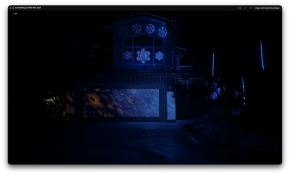
Seed Pixel Matrix using Bunnings Sheet

many people are happy to share designs so others and print them on makerworld or some of the other forums... when people download they get free stuff so I hear, option b is many people I know with printers do it so cheap you'd be best just get them to whip some more out for you and set a reasonable price.
 
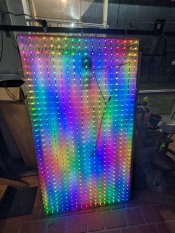
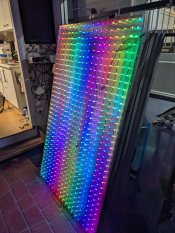
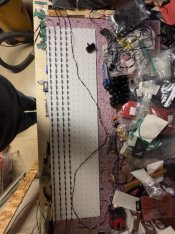
Hi everyone, wanted to share my experience trying to make a cheap matrix with 5v seeds. I decided to use this board from bunnings and pair that up with my Falcon F16V3 controller that would run the 5v seeds through 4 ports (for the whole board) resulting in a 90 row and 49 columns matrix. I used power injection every 200 pixels with a global brightness of 20% and was able to achieve the display shown in the video. Hope y'all like it!


View: https://youtu.be/ZtZ-oaaQrUw?si=bD5jXpq3mdBghr6I

Here's some more footage:
View: https://youtu.be/8LXlUTBOx5Y?si=UxxJdCXXwpg6Q9EP

Quick question before i head down this path as i think its a great idea. If there was a faulty pixel, how will you go about replacing/repairing the pixel? scotch locks wont be an option
 
I forgot about this thread.
Currently in the process of building my panels using the clear stuff to go on the solar panels.

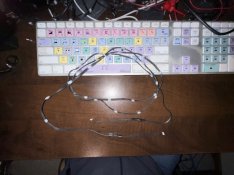
On your point @480hsv, in my case, the whole strand would need to be replaced. I have secured the ends of the strands with silicone, one end is soldered to copper tape for positive and negative power, and data is jumpered. It'd be some manual effort to replace, but not horrendously terrible.

PXL_20251106_102112936.jpgPXL_20251106_102157587.MP.jpg
 
I forgot about this thread.
Currently in the process of building my panels using the clear stuff to go on the solar panels.

On your point @480hsv, in my case, the whole strand would need to be replaced. I have secured the ends of the strands with silicone, one end is soldered to copper tape for positive and negative power, and data is jumpered. It'd be some manual effort to replace, but not horrendously terrible.

View attachment 30316View attachment 30317
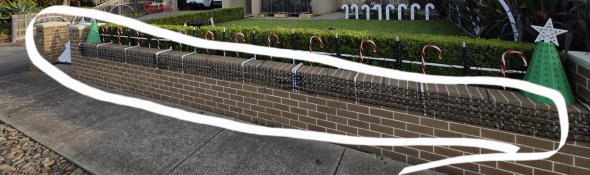
Yep ok. So the whole strand would be replaced. im thinking of making one for my front fence. 5 strands of roughly 150 pixels (roughly 7.2m long each strand). just not keen on having to pull out the whole strand.
 

Attachments

  • 20251121_183032(1).jpg
    20251121_183032(1).jpg
    863.7 KB · Views: 41
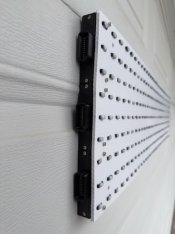
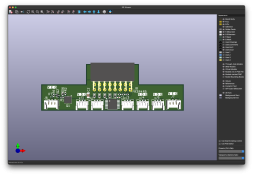
Based on the work Kent did I made some progress on my vertical and garage door matrices. My approach was to design a “matrix panel”. Each panel is cut from 4mm Coro and the seed strings are wired from an upstream PCB connection to a downstream PCB connection. The final matrix is constructed by connecting multiple panels together. The PCB auto configures the daisy chained seed strings into a zig zag. So, the resulting panel appears as one large matrix in xLights. There is provision for power distribution and balancing if required. There is an integrated switch so power can be controlled using a GPIO.


IMG_5572.jpeg


Downstream (output).png
 
Last edited:
Based on the work Kent did I made some progress on my vertical and garage door matrices. My approach was to design a “matrix panel”. Each panel is cut from 4mm Coro and the seed strings are wired from an upstream PCB connection to a downstream PCB connection. The final matrix is constructed by connecting multiple panels together. The PCB auto configures the daisy chained seed strings into a zig zag. So, the resulting panel appears as one large matrix in xLights. There is provision for power distribution and balancing if required. There is an integrated switch so power can be controlled using a GPIO.


View attachment 30638


View attachment 30639
nice work @steves! What are the connectors you're using here for the pixels?
 
nice work @steves! What are the connectors you're using here for the pixels?
I used the JST ADH connectors for the pixel strings.

For the power bus and balance connectors I chose the JST AUH connector because it has a larger wire gauge and higher current rating.

I ordered custom seed pixel lengths from Ray and had him attach the connectors. Ray used pre-crimped wires. If I could get the seed pixels manufactured with compatible wire the connectors could be attached directly.
IMG_5596.jpeg

IMG_5593.jpeg
 
I have something similar where I copied Kent’s design (thank you Kent for printing the plastic seed strips) but find the 28 cables from the falcon to the 28 strings quite bulky and when the door opens there is a risk that the cable will get caught in the door. How do you intend to connect the strings to the controller?
 
I have something similar where I copied Kent’s design (thank you Kent for printing the plastic seed strips) but find the 28 cables from the falcon to the 28 strings quite bulky and when the door opens there is a risk that the cable will get caught in the door. How do you intend to connect the strings to the controller?
I will likely use two methods. The first method ("quick method") will be to run the cables. The matrix requires 18 ports and those connections are along the left edge of the panel. I will run the cables down and around the bottom of the door and then cross over the vertical door track and use a drag chain to run the cable up the wall. From the top of the drag chain I will run the cable along and down the wall to the controller. I am in the process of setting this up now (awaiting delivery of some flexible 4 conductor cable).

The second method will take a bit more work. I could rework the PCB and use a 6 conductor (2 power + 4 signal (3 ports plus power enable)) composite/hybrid cable. In this case I would only require 6 cables. The problem with this approach is sourcing the cable. I've got a few feelers out to some suppliers in China to determine if I can get this cable. Sourcing composite cable through NA distribution is mind blowingly expensive so not really an option.

The other idea I was considering is building Scott Hanson's Pi Zero 24 board and mounting that on the door. I would then require only 6 x 2 conductor power cables and a CAT5/6 network cable. Might be able to ditch the network cable but I am not a fan of using wireless in my show. The controller runs FPP so it is capable of multi sync and so wireless might work fine.

My original plan was to build a custom low profile "matrix" controller and I did quite a bit of work on this. The idea was to mount the controller on the front of the door. I haven't really found much interest from others in the idea so I probably won't spend the time to finish that project.
 
The biggest pain of any seed project I've worked on (MT, garage matrix, porch columns) has been terminating the strings. If Ray or another supplier is willing to terminate them with a connector that has a PCB mountable mate, that is awesome. It'd be nice if he crimped them directly onto the seed wire, but I guess joining them to pre-crimped fly leads is close enough.

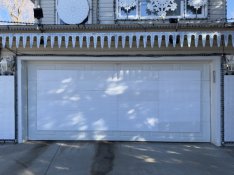
For controlling mine and minimising cable management, I designed the "Firefly controller" - a compact ESP32 8 port controller with two port switch. It has an OLED, a couple of buttons, and a 16 pin 0.1" header for installation on to a customised carrier board. The concept was people can design and build their own basic connector board which does 0.1" from the Firefly to the connector type and positioning of their choosing. Plonk as many of the controllers on as needed - 6 in the case of my 16,800 pixel garage matrix.

For the matrix, it meant only one Ethernet cable and a two core ~4mm cable were needed to be routed away from the garage. I used the dodgy flat Ethernet cables and flexible power cable with silicone insulation as both were very pliable and moved freely with the garage door.
I had planed to add a drag chain if needed, but it worked well enough without it. Maybe I'll get around to making it neater in 2026....

The beauty of the lower power seeds meant that the single power cable had no issue carrying the current needed for the entire matrix (24VDC with 24->5V DC/DC on each garage segment).

A few photos:

I note that it is now 12months+ since I promised a write up :(
...on the plus side, the six boards have lasted two seasons.

I had planned on putting the hardware design and firmware up on Github, plus offer prebuilt Firefly controller boards, but just haven't found the time. If there is interest in the project, it may give me the motivation to publish it.

Alternatively, now that the Baldrick range has two port switch on some designs perhaps @domhodgson may see some merit in offering a controller with the same features / form factor as the Firefly - it'd have the benefit of actively developed firmware and much better support.
 
The biggest pain of any seed project I've worked on (MT, garage matrix, porch columns) has been terminating the strings. If Ray or another supplier is willing to terminate them with a connector that has a PCB mountable mate, that is awesome. It'd be nice if he crimped them directly onto the seed wire, but I guess joining them to pre-crimped fly leads is close enough.

For controlling mine and minimising cable management, I designed the "Firefly controller" - a compact ESP32 8 port controller with two port switch. It has an OLED, a couple of buttons, and a 16 pin 0.1" header for installation on to a customised carrier board. The concept was people can design and build their own basic connector board which does 0.1" from the Firefly to the connector type and positioning of their choosing. Plonk as many of the controllers on as needed - 6 in the case of my 16,800 pixel garage matrix.

For the matrix, it meant only one Ethernet cable and a two core ~4mm cable were needed to be routed away from the garage. I used the dodgy flat Ethernet cables and flexible power cable with silicone insulation as both were very pliable and moved freely with the garage door.
I had planed to add a drag chain if needed, but it worked well enough without it. Maybe I'll get around to making it neater in 2026....

The beauty of the lower power seeds meant that the single power cable had no issue carrying the current needed for the entire matrix (24VDC with 24->5V DC/DC on each garage segment).

A few photos:

I note that it is now 12months+ since I promised a write up :(
...on the plus side, the six boards have lasted two seasons.

I had planned on putting the hardware design and firmware up on Github, plus offer prebuilt Firefly controller boards, but just haven't found the time. If there is interest in the project, it may give me the motivation to publish it.

Alternatively, now that the Baldrick range has two port switch on some designs perhaps @domhodgson may see some merit in offering a controller with the same features / form factor as the Firefly - it'd have the benefit of actively developed firmware and much better support.
A Baldrick8 with 2 ports eh? Theres an idea.
 
Back
Top